Report · Tibet
Tibet: Human Rights and the Rule of Law
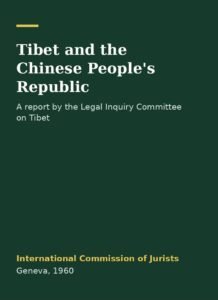
A report by the International Commission of Jurists
by International Commission of Jurists · 1997
About the report
This report by the International Commission of Jurists examines the rule of law and human rights in Tibet, including self-determination, economic, social and cultural rights, and civil and political rights. It covers the whole period since China’s invasion of central Tibet in 1950, with a focus on the 1990s.
The report finds that repression increased steadily after the 1994 Third National Forum on Work in Tibet, which blamed the Dalai Lama’s influence for instability and endorsed rapid development, including moving more Chinese people into the Tibet Autonomous Region. This led to tighter control of religion, a denunciation campaign against the Dalai Lama, more political arrests and surveillance, re-education in monasteries, and the continued detention of the boy recognised by the Dalai Lama as the Panchen Lama.
The ICJ concludes that these abuses flow from the denial of the Tibetan people’s right to self-determination, and that China encourages Chinese settlement in Tibet in order to colonise unwilling subjects. Its principal recommendation is a referendum in Tibet under United Nations supervision to ascertain the wishes of the Tibetan people.
Read the report? Take the next step.
Join a Tibet solidarity group near you, travel with a delegation to Tibet, or become part of Solidarity Rising.
More reports on Tibet


Related resources

Erasure & Ecocide: Post 2019, India’s Legal Re-Engineering is Hollowing Out Kashmir’s Rivers and Forests
Tarushi Aswani reports how India's post-2019 legal changes have opened…
Mining in Tibet in 2026: The Copper Boom, Troubled Rivers and the Question of Who Benefits
Tenzin Jigmey examines the copper boom on the Tibetan Plateau, its effects on…
Western Sahara: the law of the strongest returns to the UN
Abdelkader Abderrahmane and Yahia H. Zoubir argue that by yielding to Western…