Memorandum on the latest developments in Western Sahara
Morocco has illegally occupied part of Western Sahara for more than 47 years, a UN-listed Non-Self-Governing Territory since 1963, in violation of core international law principles and the UN Charter; the ICJ’s 1975 ruling found no historical tie of sovereignty between Western Sahara and Morocco. The UN, African Union, and EU have not recognized Morocco’s occupation/annexation, which the UN Security Council and General Assembly have repeatedly criticized and described as a continued occupation. The memorandum argues the dispute remains unresolved due to Morocco’s obstruction and international inaction, including Morocco’s failure to honor the UN–OAU Settlement Plan (accepted in 1988 and approved by the Security Council in 1990–91) and its continued blocking of the agreed referendum on Sahrawi self-determination.
Mission report following the visit to Western Sahara on 3 and 4 September 2018
A three-member delegation from Parliament’s INTA committee visited Western Sahara on 3–4 September 2018. The mission—authorised by the Parliament’s Conference of Presidents on 5 July 2018—took place as part of preparations for Parliament’s recommendation on approving an agreement extending EU–Morocco trade preferences to products from Western Sahara, mainly agricultural goods (tomatoes and melons) and fishery products. The programme included six meetings with Sahrawi civil society associations, two meetings with official authorities, one meeting with a human rights association, one with the French Chamber of Commerce, and six field visits.
Observations and Topics to be Included in the List of Issues
From a legal standpoint, the Sahrawi people are unequivocally entitled to determine their political future through a referendum on self-determination. The United Nations General Assembly, the International Court of Justice, and the Organization of African Unity have all affirmed that Morocco cannot exercise sovereignty over the non-self-governing territory of Western Sahara and have called for a referendum so that the Sahrawi people can decide their political status. This report seeks to highlight several violations by the Kingdom of Morocco of the International Covenant on Economic, Social and Cultural Rights (ICESCR) in the non-self-governing territory of Western Sahara.
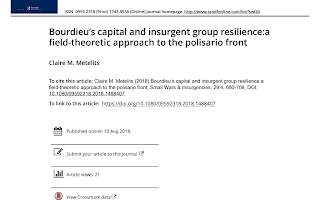
Bourdieu’s capital and insurgent group resilience:a field-theoretic approach to the polisario front
The conflict between the Polisario Front and the Kingdom of Morocco is approaching its 43rd year and, despite being under-reported, continues to draw attention for the resilience of the ethnically Sahrawi rebel movement. Even as regional and international politics have shifted—and with nearly 150,000 Sahrawi refugees living in camps in Algeria—the Polisario Front has endured. This article asks what explains that persistence and applies Bourdieu’s “forms of capital” as an analytical lens.
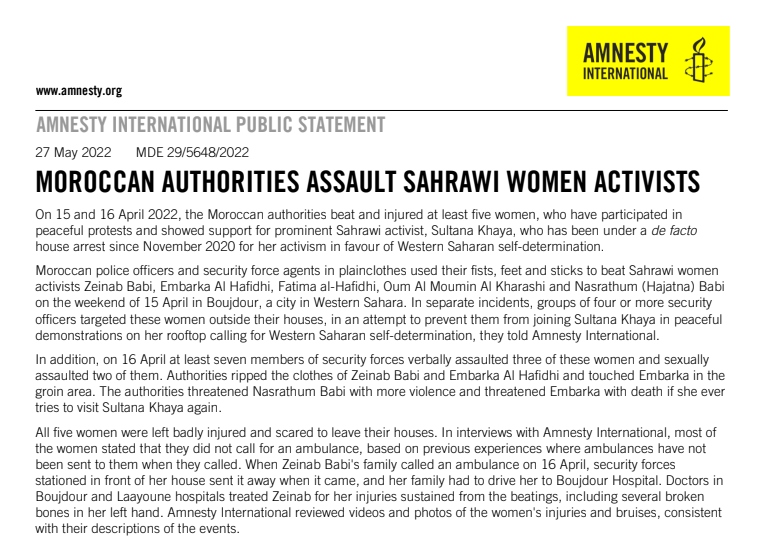
Amnesty International public statement: Moroccan authorities assault Sahrawi women activists
On 15–16 April 2022, Moroccan authorities beat and injured at least five Sahrawi women for participating in peaceful protests in support of prominent activist Sultana Khaya, who has been under de facto house arrest since November 2020 because of her advocacy of Western Saharan self-determination.